Regenerative Spotted Lanternfly-Based Food System
The aim of this project is twofold. First, it seeks to produce a medicinal honey, known as honeydew honey, by feeding bees the secretions of Spotted Lanternflies (SLF). Second, it aims to reduce the population of this invasive species in the United States.
The Spotted Lanternfly (SLF), a planthopper indigenous to China and Vietnam, has emerged as a significant invasive threat in North America, with Allegheny County, Pennsylvania, alone accounting for nearly one-quarter of all U.S. sightings. This project addresses the ecological challenge by leveraging the SLF's symbiotic relationship with the Tree of Heaven, another invasive Chinese species, which serves as the primary source for the insect's honeydew. By harvesting this byproduct to produce medicinal honey, we aim to transform a pervasive environmental burden into a high-value medicinal resource.
01
SystemOur project proposes a plan that starts in public parks around Allegheny County, Pennsylvania, and ends with the distribution of the produced Honeydew Honey. We plan to take saplings of the invasive Tree of Heaven and replant them in several public parks, where they can be watered and maintained by the existing park maintenance service. Our trap (explained below), positioned around the Tree of Heaven, attracts and traps Spotted Lanternflies. The Tree of Heaven acts as a home and source of nourishment to these Lanternflies. Their secretion, known as Honeydew, is collected and transported to a centralized aviary where it is bottled and fed to a colony of bees. This Honeydew Honey produced has shown to have medicinal properties, and allows for a second round of honey harvest.
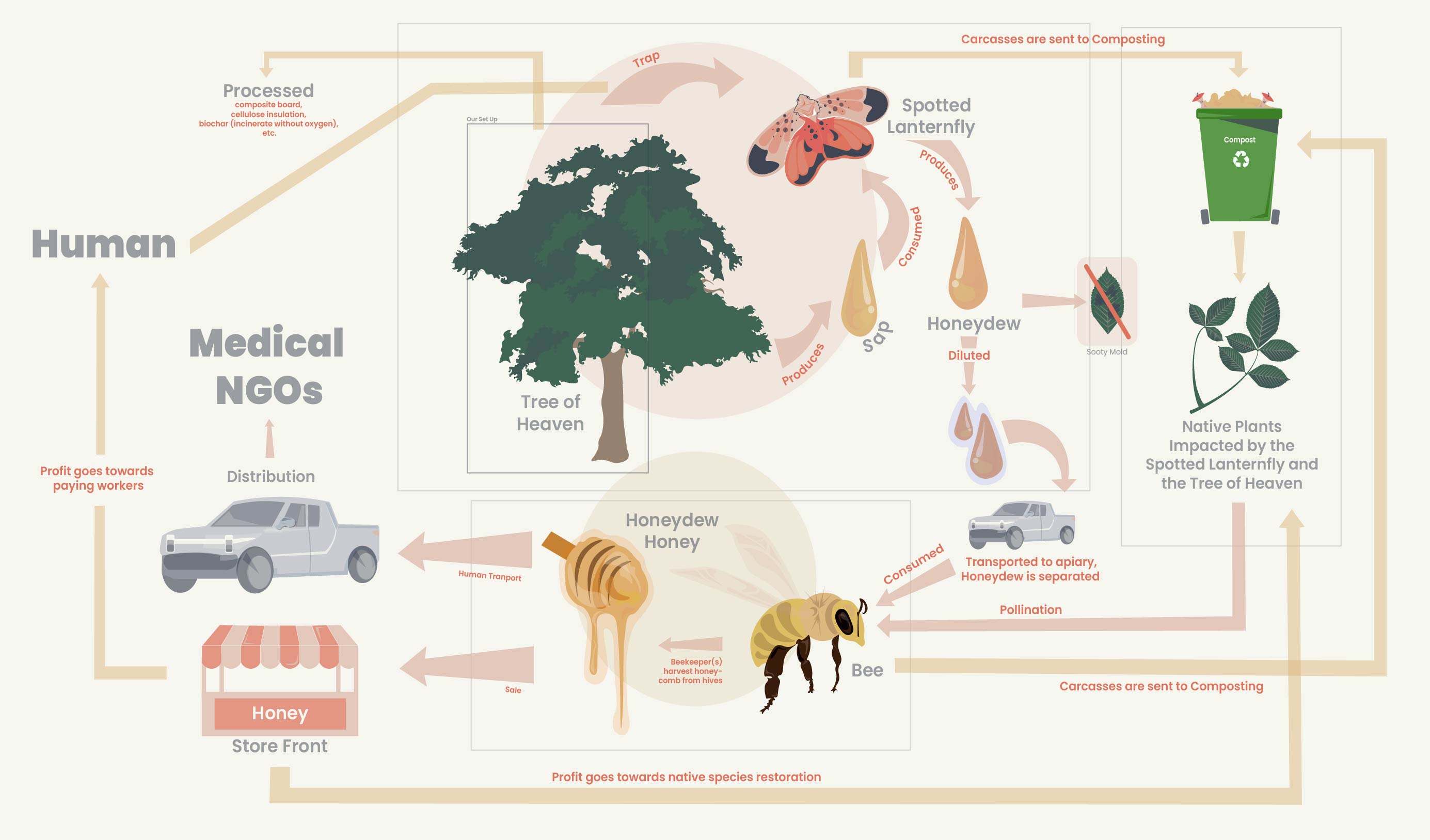
The Honeydew Honey is collected to be given to Medical NGOs in need, and sold at the site to the public. Proceeds from these sales go towards paying workers, and maintenance costs.
The Spotted Lanternfly eggs are eradicated at the end of every cycle using neem oil. They are collected into the waste bins and are transported to the compost facility along with other organic waste.
02
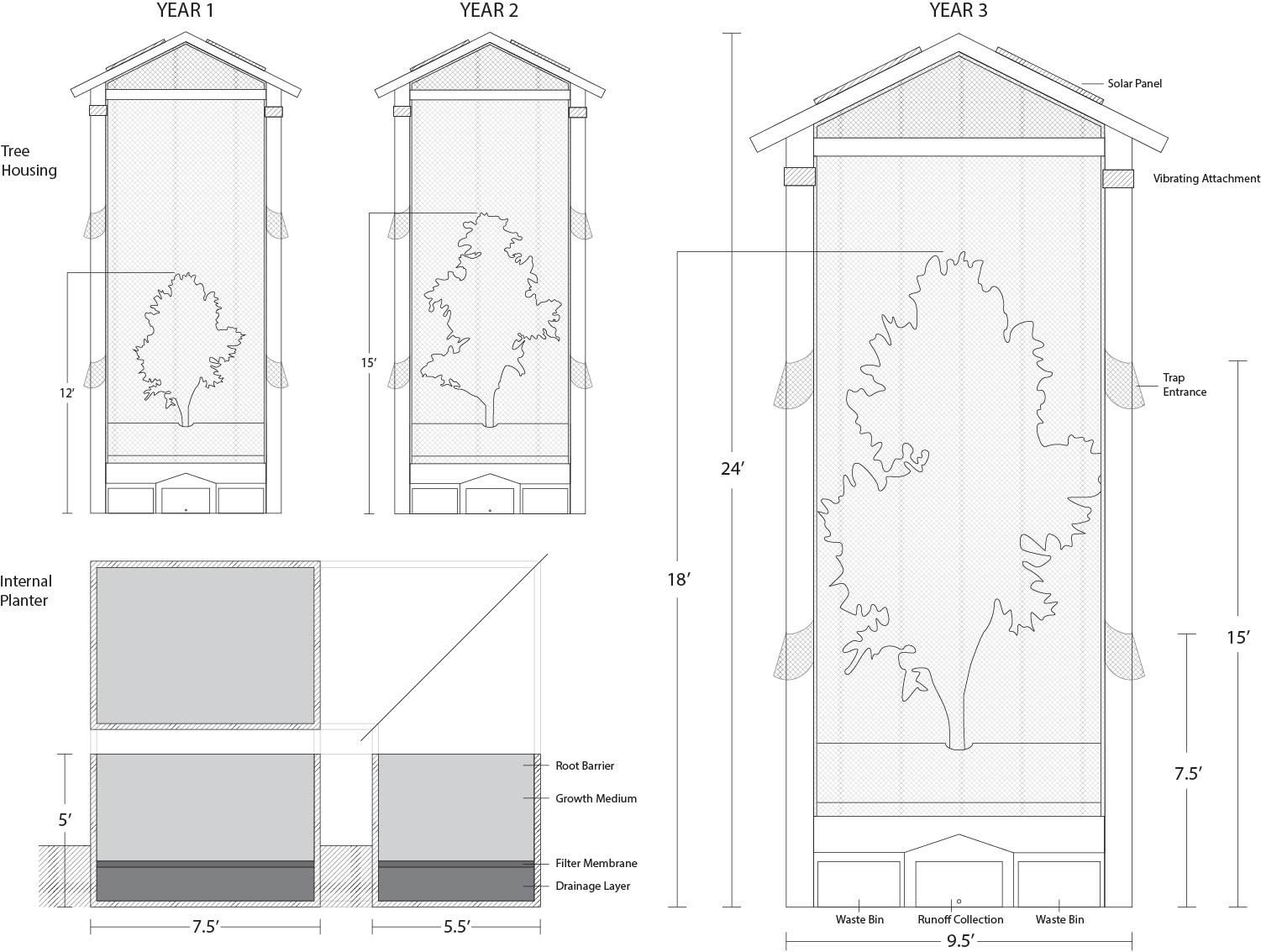
TrapThe Tree of Heaven Sapling is transplanted into a root barrier to ensure containment of its toxins. A 24-foot-tall structure is constructed around the sapling to contain the incoming Spotted Lanternflies.
The structure stands on four wooden poles, which vibrate at a 60 Hz frequency to attract the Spotted Lanternflies. The top is constructed of two transparent panels placed at a 120° angle to hold two solar panels that power this sprinkler system. Sprinklers that rotate at a 45° angle run all along this structure.
Circle traps, similar to those currently used to trap Lanternflies, are placed along these poles at different heights.
03