DESIGN PORTFOLIO
NASA x RISD Suits
2024 - 2025 Left Workflow Panel
During the 2024-25 NASA Spacesuit User Interface Technologies for Students (NASA SUITS) competition, I collaborated with Project Manager Su Hyun Ahn, Chief Designer Linlin Yu, Chief UI Designer Anna Wang, and designers Ava Maghsoodlou, Anushka Parikh, and Bennett Graff to create the Left Workflow Panel.
01
Project DescriptionThe RISD SUITS team proposed and designed a system for the Pressurized Rover (PR) to support more efficient and intuitive lunar surface exploration. Grounded in key pain points experienced by astronauts during EVs, particularly information overload and the difficulty of maneuvering handheld tools, the system prioritizes flexibility, spatial awareness, and reduced cognitive stress. The proposal responds to the challenges PRs face in supporting EV activities in extreme environments, while increasing user confidence, improving task performance, and ultimately reducing mission risk.
The system was designed across two desktop displays. The left interface houses mission details, including action items and navigation, while the right focuses on critical vitals for both the Pressurized Rover and the EVs.
The system was designed across two desktop displays. The left interface houses mission details, including action items and navigation, while the right focuses on critical vitals for both the Pressurized Rover and the EVs.
02
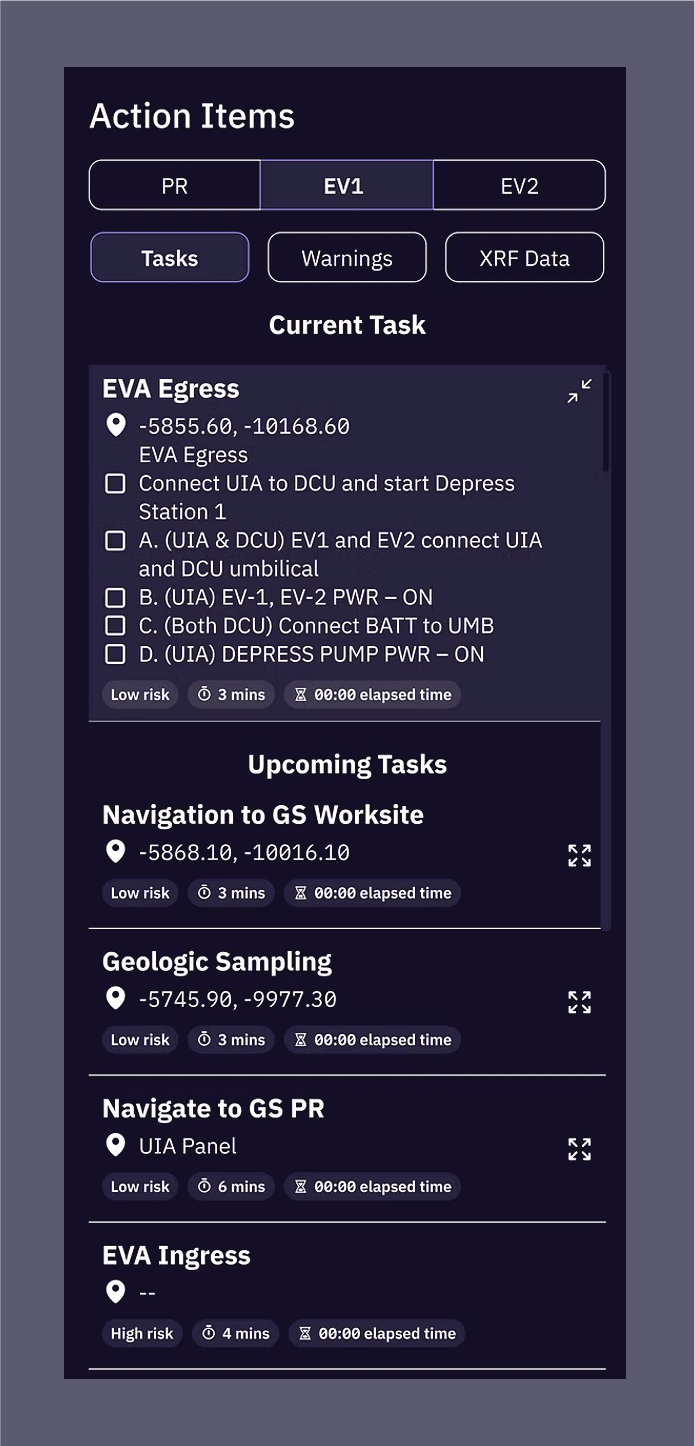
Left Workflow PanelThe Left Workflow Panel is where astronauts in the Pressurized Rover find and sort information regarding Tasks, Warnings, and Data Collected by EVs during Geological Sampling (Terrain Data or XRF Data).
The panel is broken down based on Entities - PR, EV1 and EV2.
Each entity is further divided into three sections: Tasks, Warnings, and Terrain Data.
The panel is broken down based on Entities - PR, EV1 and EV2.
Each entity is further divided into three sections: Tasks, Warnings, and Terrain Data.
03
EVs and the PR are required to complete a series of mission tasks on the lunar surface, including PR terrain scouting, EVA egress, navigation, geological sampling, and EVA ingress. The lunar environment is extreme and high-stakes, resulting in elevated stress levels for the crew. To maintain a streamlined workflow with minimal room for error, every step of each task performed by EVs is supported and cross-checked by the PR. As a result, all tasks and their associated steps like estimated time, risk level, and other critical parameters are displayed to the PR in real time. They have the ability to edit, override, or advise against tasks as they see fit. Tasks are displayed according to their timeline, beginning with current tasks, followed by upcoming tasks, and concluding with completed tasks.
04Warnings
When the system detects an upcoming risk, a warning is displayed to alert the PR crew. These warnings initially hover over the map before being stored in a warning archive. Each warning is categorized by level of importance - red for critical, yellow for important, and green for confirmation. As the PR may not be able to respond to every yellow warning in real time, unresolved warnings are stored in the left panel, where they can be reviewed and addressed later. A small red indicator signals the presence of pending warnings, maintaining awareness without cluttering the field of view.
05XRF or Terrain Data
Data collected by EVs during geological sampling is translated into categories, sorted, and stored under Terrain Data. Each entry displays the sample name, the coordinates at which it was collected, the time of collection, nearby landmarks, and its material composition. The system also allows users to add voice notes for additional context or bookmark samples for quick and easy access.
06